Blending Climate Impacts: Monitoring & Evaluating A&R and Emissions Impact with Green Climate Fund
As Project Frame expands its scope beyond climate change mitigation, we continue to ask ourselves: what are best practices for assessing novel climate solutions for both greenhouse gas (GHG) emissions and adaptation & resilience impact?
On April 30, 2026, Frame held its second Community Meeting of the year to tackle that very question and glean insights from the world’s largest dedicated fund for climate action. We were joined by Green Climate Fund (GCF) Monitoring & Evaluation Specialist Johan Vandebeek, who shared how GCF integrates both climate change mitigation and Adaptation & Resilience (A&R) impact into their investment process.
Introducing Green Climate Fund
“There is some parallel with our approach and with the Project Frame approach to measuring climate impact. I think that's the most interesting thing: sharing knowledge, helping each other, and coming up with a common language,” Johan Vandeek shared.
Vandebeek has over a decade of experience connecting capital with measurable impact across projects in renewable energy and industrial decarbonization. With a background in management consulting and lender advisory, he has supported investments ranging from $50M to $10B. He specializes in portfolio analytics and results measurement, strengthening the link between funding and real-world outcomes.
The Green Climate Fund is a pivotal global platform established within the framework of the United Nations Framework Convention on Climate Change (UNFCCC) to serve as a central pillar of international climate finance. Formally conceived during the 2010 COP16 summit in Cancun, Mexico, the fund was designed to help fulfill the financial commitments of the Paris Agreement by supporting the efforts of developing countries.
The GCF plays a critical role in mobilizing financial resources at scale to promote a paradigm shift toward low-emission and climate-resilient development. Headquartered in Incheon, South Korea, the GCF operates through a diverse network of "Accredited Entities"—ranging from international banks to local NGOs—to invest in projects that mitigate greenhouse gas emissions and assist vulnerable communities in adapting to the increasingly severe impacts of a warming planet.
Impact at a Glance
Since 2015, GCF has reduced 95 MtCO2e while managing $443.2M in resilient and low-emission assets. They have a final target (attributed) of 431 MtCO2e, which only accounts for the impact of the 5 - 10 years of direct GCF assistance. However, their lifetime target of 3.3 Billion tCO2e includes the projects’ entire lifetime impact beyond direct GCF support. They have reached 249.3M beneficiaries through climate action and installed, generated, or rehabilitated 7,276 MW of low-emission energy capacity.
While these high-level metrics are impressive, how did they collect and measure these results?
Avoiding Carbon Tunnel Vision: A Holistic Approach to Climate Impact Assessment
Vandebeek cautioned the community against "carbon tunnel vision," arguing that while greenhouse gas accounting remains a cornerstone of climate action, it should not be the sole metric of success.
A truly holistic assessment accounts for the "triple dividend" of resilience, which includes avoided losses, economic gains from lower risk, and social and environmental co-benefits. This approach is rooted in a rigorous Theory of Change framework that carefully distinguishes between immediate outputs, such as the installation of solar capacity, and long-term outcomes like sustained behavioral shifts or the permanent displacement of fossil fuels.
"There's often now, in academic literature, a fourth dividend in adaptation, and that's peacekeeping or peacebuilding,” Vandebeek said. “The climate-conflict nexus is a very important element to include.”
Mitigation Impact Potential
When measuring mitigation impacts, GCF is aligned with Project Frame’s approach to Potential Impact when setting the project boundary, baseline, and counterfactual, and assessing additionality. Because they invest exclusively in developing countries, GCF often undertakes pilot projects that have never been done in those countries, making Frame’s Planned Impact approach less applicable given its need for realistic annual sales projections.
GCF approaches mitigation impact potential from a systemic perspective, and they always consider rebound effects, leakage, and displacement on net outcomes, corresponding to Project Frame’s optional adjustment factors.
Consistent with Project Frame’s Principle of Conservatism, GCF is cautious not to overestimate impact, in agreement with national GHG reporting for the given deployment site.
Due to reporting requirements, they also use backward-looking GHG impact measurements, or what Project Frame calls Realized Impact.
Adaptation Impact Potential
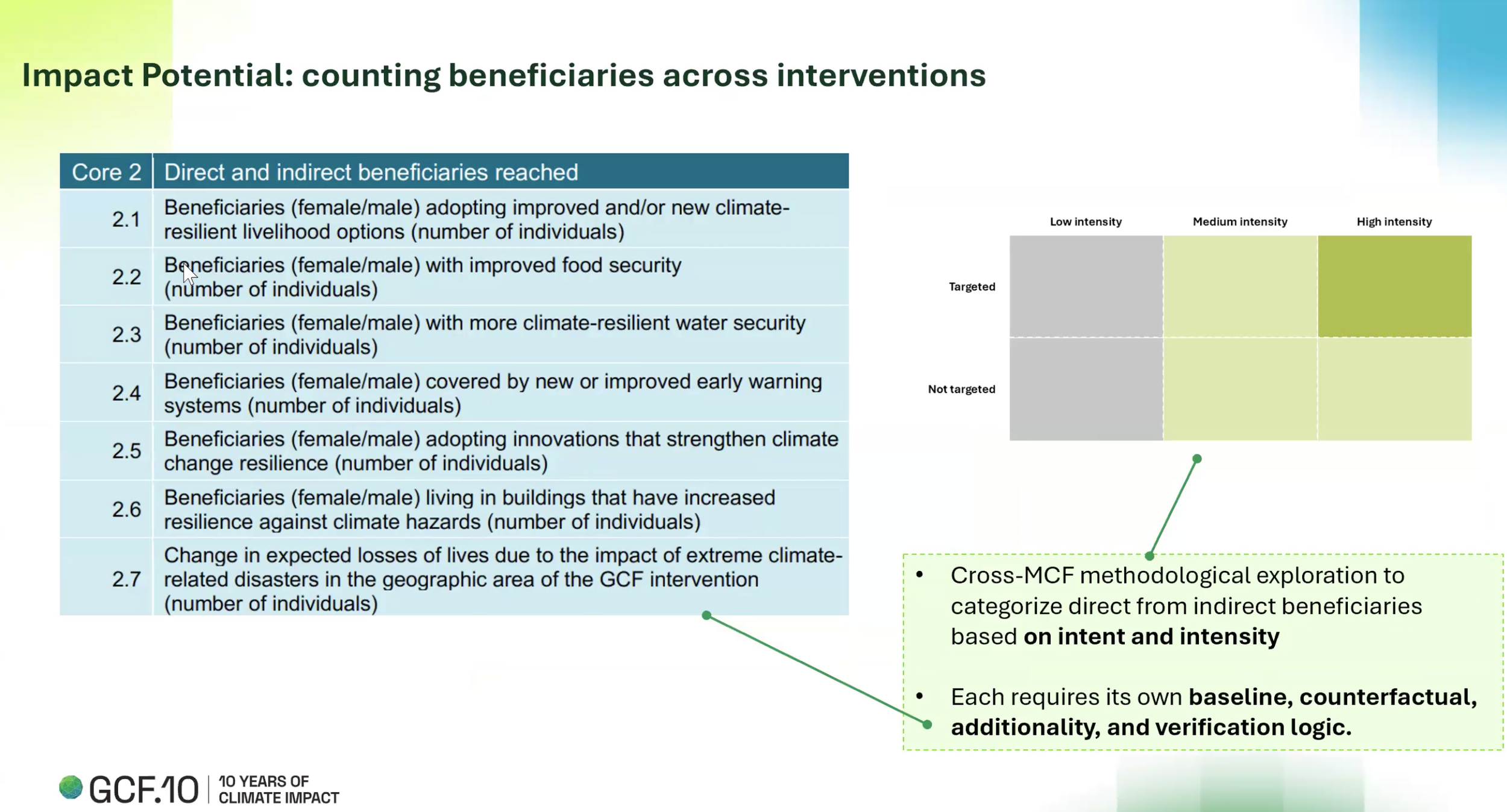
GCF recognizes that adaptation is about people and involves a more sensitive approach. They start with system-wide planning, a top-down approach, looking at how to build resilience across the whole system, not at the level of an individual asset or service alone. They make decisions that align with the country’s national plans, hold up across a range of climate futures and explicitly avoid maladaptation.
Simultaneously, they blend a bottom-up approach by incorporating locally-led climate action and bringing decision-making, finance, and accountability to the climate-vulnerable communities the solutions impact. Furthermore, they seek to build local ownership, capacity, and an enabling environment for sustained resilience.
Beyond risk identification and response planning, GCF measures impact through the number of beneficiaries (both direct and indirect) that receive a measurable adaptation benefit. An adaptation benefit is defined as an outcome that increases the resilience or reduces the vulnerability of the target system against adverse effects of climate change, compared to a baseline scenario.
Impact Assessment Methodological Tensions
GCF recognizes that IMM is ever-evolving. They continue to update their approach as best practices emerge and new insights and knowledge are shared throughout the climate finance field.
“[Measuring impact potential] creates tensions,” Vandebeek said, “More often than not, it is more of an art than it is a science. So that is why it is important to have initiatives like Project Frame, not to come up with all the solutions, but at least a common language to speak about the approaches of how to assess these problems.”
Some of the tensions Vandebeek identified include:
Accuracy vs. Completeness: Wide enough to capture rebound and value-chain effects; narrow enough to be defensible.
Provable vs. Probable Additionality: Counterfactual certainty (mathematically impossible) versus confidence-threshold-based judgement
Allocational vs. Consequential: Inventory view versus intervention lens
Attribution vs. Contribution: Splitting credit among multiple actors
Looking Forward Toward A&R Impact Assessment Frameworks
In June 2026, Project Frame will initiate its inaugural Adaptation & Resilience Case Study Working Group, organized in partnership with Tailwind Futures and MaRS’ Adaptech Accelerator. This initiative is an early step toward establishing a robust A&R impact framework driven by consensus within the Project Frame community.
As Vandebeek and GCF remind us, it is important to transcend "carbon tunnel vision" by incorporating adaptation impact assessments into climate solutions investing. This is particularly urgent as the manifestations of climate change increasingly impact the most vulnerable global communities.
To stay up-to-date about Frame’s work in Adaptation & Resilience impact assessment, sign up for our newsletter to be the first to know about new resources, case studies, or opportunities to get involved.